
Categories
Top Posts
GST Return Filing

Legal Services
Taxpayers

GST Return Filing
Legal Services

Legal Services

GST Registration

Taxpayers

Legal Services

Legal Services
Taxpayers

Legal Services
Taxpayers

Legal Services
GST Registration
Taxpayers

Legal Services

Legal Services

Legal Services

Legal Services

Legal Services

EPR Management

EPR Management

Legal Services

Legal Services
Taxpayers
Social Audit

Taxpayers

GST Return Filing

Legal Services
Legal Services

Legal Services

GST Return Filing

GST Registration

Legal Services
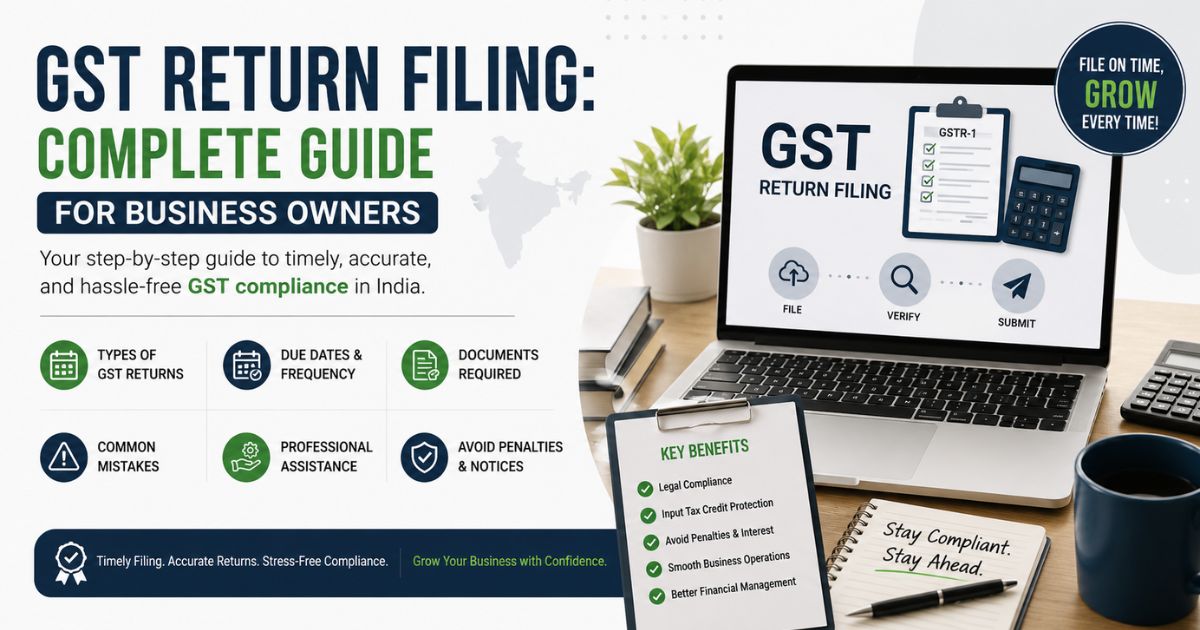
GST Return Filing: Complete Guide for Business Owners
Posted: 2 months ago
What Is GST Return Filing?
GST return filing is the process where a registered taxpayer reports details of sales, purchases, input tax credit (ITC), tax collected, and tax payable to the government.
Depending on the taxpayer's registration type, turnover, and the applicable GST scheme, different returns may need to be filed.
In simple terms:
Business transactions, GST records, GST return, tax payment, filing.
Even if there are no business transactions during a specific tax period, a taxpayer might still have to file a Nil GST return, based on the applicable return and registration status.
Why Is GST Return Filing Important for Businesses?
Proper GST filing is essential. It helps keep accurate business records.
1. Avoid Penalties and Interest
Filing late or delaying GST payment can lead to late fees and interest. Staying compliant helps businesses avoid unnecessary costs.
2. Claim Eligible Input Tax Credit
Accurate reporting of purchases and eligible ITC is crucial for businesses that want to claim credits allowed under GST law.
3. Reduce the Risk of GST Notices
Mistakes or inconsistencies between invoices, books of accounts, GSTR-1, GSTR-3B, and other GST data can increase the chances of inquiries or notices from GST authorities.
4. Maintain Business Credibility
Regular GST compliance is beneficial when interacting with customers, vendors, banks, investors, and other business stakeholders.
5. Support Accurate Financial Reporting
GST returns should match with accounting records. This helps identify missing invoices, incorrect tax rates, duplicate entries, and other accounting mistakes.
Types of GST Returns
There are several GST return forms under the GST framework. The return a business needs to file depends on its registration type and circumstances.
GSTR-1
GSTR-1 mainly includes details of outward supplies made by a registered taxpayer.
It may cover information such as:
B2B sales,
B2C sales,
Export supplies,
Debit and credit notes,
Changes to previously reported invoices.
The details reported in GSTR-1 can also affect what invoice information is available to the recipient.
GSTR-3B
GSTR-3B is a summary return where taxpayers report relevant outward supplies, eligible input tax credit, and GST liability.
The taxpayer typically pays the applicable tax liability through the GST portal while filing the return.
GSTR-9
GSTR-9 is the annual return required for specified taxpayers, based on the provisions, exemptions, and turnover thresholds for the relevant financial year.
It offers an annual summary of GST-related transactions reported during the year.
GSTR-9C
GSTR-9C is a reconciliation statement needed for specific taxpayers under the conditions and thresholds set by GST law.
Businesses should check the current rules and requirements for the relevant financial year before filing.
GST Return Filing Process
Basic GST filing for a business can be understood through these steps:
Step 1: Maintain Proper GST Records
Keep sales invoices, purchase invoices, debit notes, credit notes, expense records, payment records, and other relevant documents well organized.
Step 2: Record Sales and Purchase Transactions
Ensure that transactions recorded in accounting software or books match the actual invoices issued and received.
Step 3: Reconcile Purchase Data
Compare purchase records and eligible ITC with information available through the GST system, and identify any mismatches.
Step 4: Prepare GST Returns
Prepare the relevant GST returns based on the taxpayer's registration type and applicable filing frequency.
Step 5: Review Tax Liability and ITC
Before filing, check:
Output GST,
Eligible ITC,
ITC reversals, if applicable,
Reverse charge liability, if applicable,
Tax payable,
Interest or late fee, if applicable.
Step 6: File the Return
After reviewing the information, submit the applicable return through the GST portal using the required authentication method.
Step 7: Maintain Filing Records
Keep copies of filed returns, challans, invoices, reconciliations, and other supporting documents for future reference and compliance needs.
Common GST Return Filing Mistakes
Businesses often face GST compliance issues due to simple reporting errors.
Incorrect GSTIN
Entering the wrong customer's or supplier's GSTIN can lead to reconciliation problems.
Wrong Tax Rate
Applying the wrong GST rate can result in short payments, overpayments, or subsequent amendments.
Missing Invoices
Not reporting invoices in the relevant return may affect the taxpayer and the recipient's ITC reconciliation.
Incorrect Input Tax Credit
Businesses should claim only eligible ITC after reviewing the applicable GST rules.
Sales and GST Returns Not Reconciled
Differences between books, invoices, GSTR-1, and GSTR-3B can create compliance risks.
Ignoring Credit Notes and Amendments
Credit notes, debit notes, and amendments should be accounted for and reported where necessary.
Filing Returns at the Last Minute
Last-minute filing increases the risk of errors, missed invoices, technical problems, and delayed payments.
Documents and Information Required for GST Filing
Requirements can vary by business, but commonly needed information includes:
Sales invoices,
Purchase invoices,
Debit and credit notes,
Expense details,
Bank and payment records,
GST registration details,
Export details, if applicable,
Reverse charge transactions, if applicable,
Input tax credit information,
Previous return details,
Relevant accounting records.
Keeping these records organized makes monthly or quarterly GST compliance much easier.
GST Return Filing for Small Businesses
Small businesses may think GST compliance is complicated only for larger firms. However, even small businesses can face notices, interest, penalties, or ITC issues from incorrect returns.
For small businesses, a simple compliance system can make a big difference:
Maintain invoices, update books regularly, reconcile GST data, review returns, file on time.
If transaction volumes increase, businesses should think about using accounting and GST compliance systems to reduce manual errors.
How GST Reconciliation Helps Your Business
GST reconciliation means comparing information from various records and spotting differences.
For example:
Books of Accounts, Sales Invoices, GSTR-1, GSTR-3B, Purchase/ITC Records.
Regular reconciliation can help identify:
Missing sales invoices,
Duplicate invoices,
Incorrect GSTINs,
Wrong tax rates,
ITC mismatches,
Unreported credit notes,
Differences between books and GST returns.
This makes reconciliation an important part of effective GST compliance.
What Happens If GST Returns Are Filed Late?
Late GST filing may result in late fees and interest, based on the nature of the return and circumstances.
More importantly, repeated non-compliance can create issues like:
Accumulation of pending returns,
Difficulty claiming or reconciling ITC,
GST notices or queries,
Cash-flow pressure due to tax liabilities,
Additional compliance work.
Thus, businesses should treat GST return filing as a routine process, not a last-minute task.
Should You Handle GST Filing Yourself or Hire a Professional?
Businesses with simple transactions and enough accounting knowledge may handle routine GST compliance on their own.
However, professional help can be beneficial for businesses with:
High transaction volumes,
Multiple GST registrations,
E-commerce sales,
Inter-state transactions,
Import/export transactions,
Reverse charge transactions,
Complex ITC issues,
GST notices or litigation,
Frequent invoice amendments,
Significant reconciliation differences.
A professional can assist with return preparation, reconciliation, compliance reviews, and identifying potential issues before they escalate.
GST Return Filing Checklist for Business Owners
Before filing your GST return, check the following:
All sales invoices are recorded,
Purchase invoices are recorded correctly,
GSTINs have been verified,
GST rates and tax amounts have been reviewed,
Credit notes and debit notes are accounted for,
Eligible ITC has been checked,
Applicable ITC reversals have been considered,
Reverse charge transactions have been reviewed,
Books and GST data have been reconciled,
Tax liability has been double-checked,
Applicable interest and late fees have been confirmed,
The return has been filed by the due date.
Frequently Asked Questions About GST Return Filing
Is GST return filing mandatory?
GST return filing depends on the taxpayer's GST registration and relevant provisions. A registered taxpayer should determine which returns apply to their business and file them within the set deadlines.
Can a Nil GST return be filed?
Yes, if applicable, a taxpayer with no reportable transactions may need to file a Nil return instead of neglecting the filing requirement.
What is the difference between GSTR-1 and GSTR-3B?
GSTR-1 mainly reports details of outward supplies, while GSTR-3B is a summary return covering relevant supplies, ITC, and tax liability.
Can GST returns be revised?
Generally, GST returns do not have the same revision process as income tax returns. Errors are usually corrected using mechanisms available under the GST framework, including amendments in later periods where allowed.
How can businesses avoid GST compliance problems?
The best way is to keep accurate invoices and accounting records, reconcile GST data regularly, claim only eligible ITC, track due dates, and review returns before filing.
Final Takeaway
GST return filing is more than just submitting a form on the GST portal. It involves accurate bookkeeping, invoice management, ITC verification, reconciliation, tax calculations, and timely compliance.
For business owners, a systematic approach to GST filing can help reduce errors, avoid unnecessary costs, improve financial clarity, and lessen compliance risks.
If managing GST returns takes time away from your core business.
activities, professional support can help you manage routine filing, reconciliation, and GST compliance more efficiently.
Need help with GST return filing?
Connect with a professional GST consultant to review your business transactions, filing requirements, ITC reconciliation, and ongoing GST compliance.
